In defence of a bird we take for granted
The pheasant deserves better.
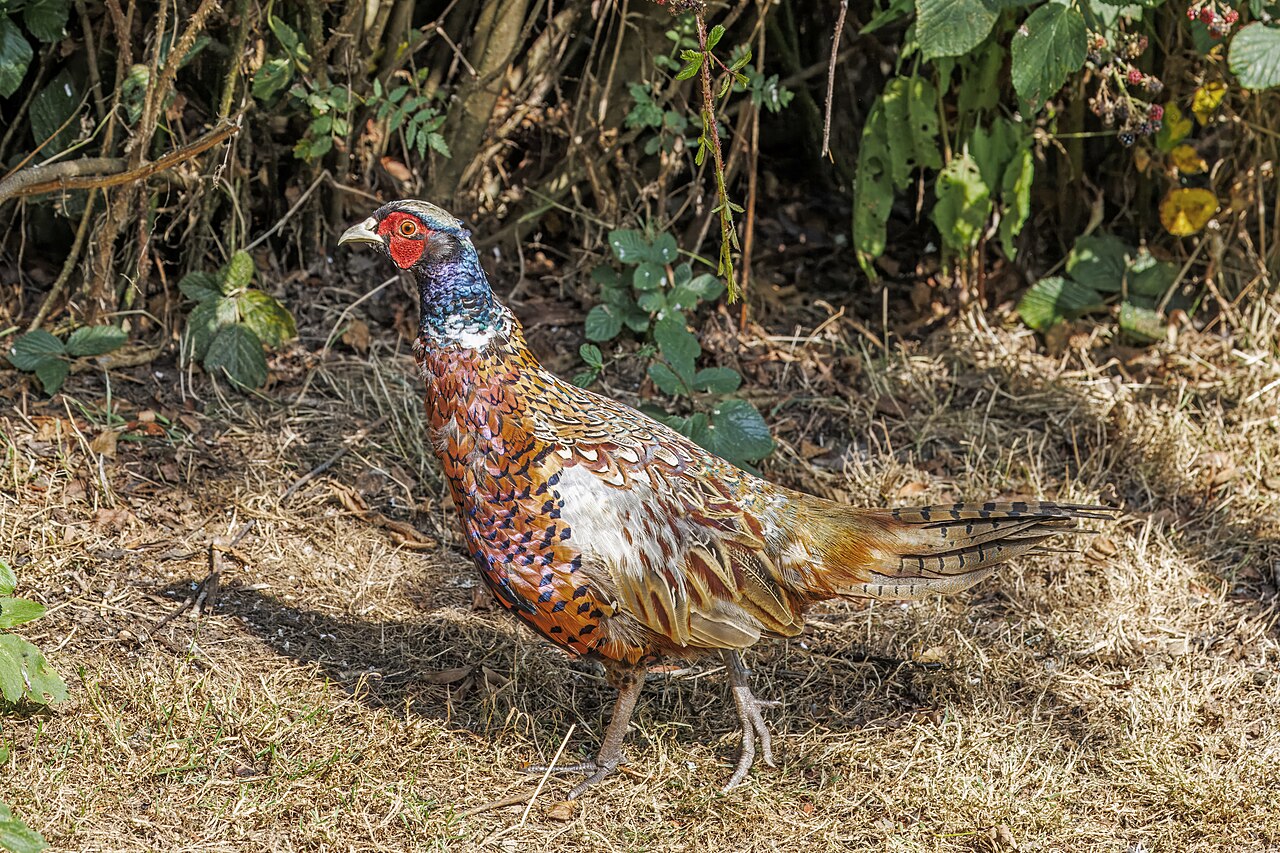
A walking firework of copper, bronze and bottle-green, with a scarlet face and a tail longer than its body. We have made it the most abundant bird in Britain, and then arranged for most of it to be shot. This page is about why that is worth rethinking.
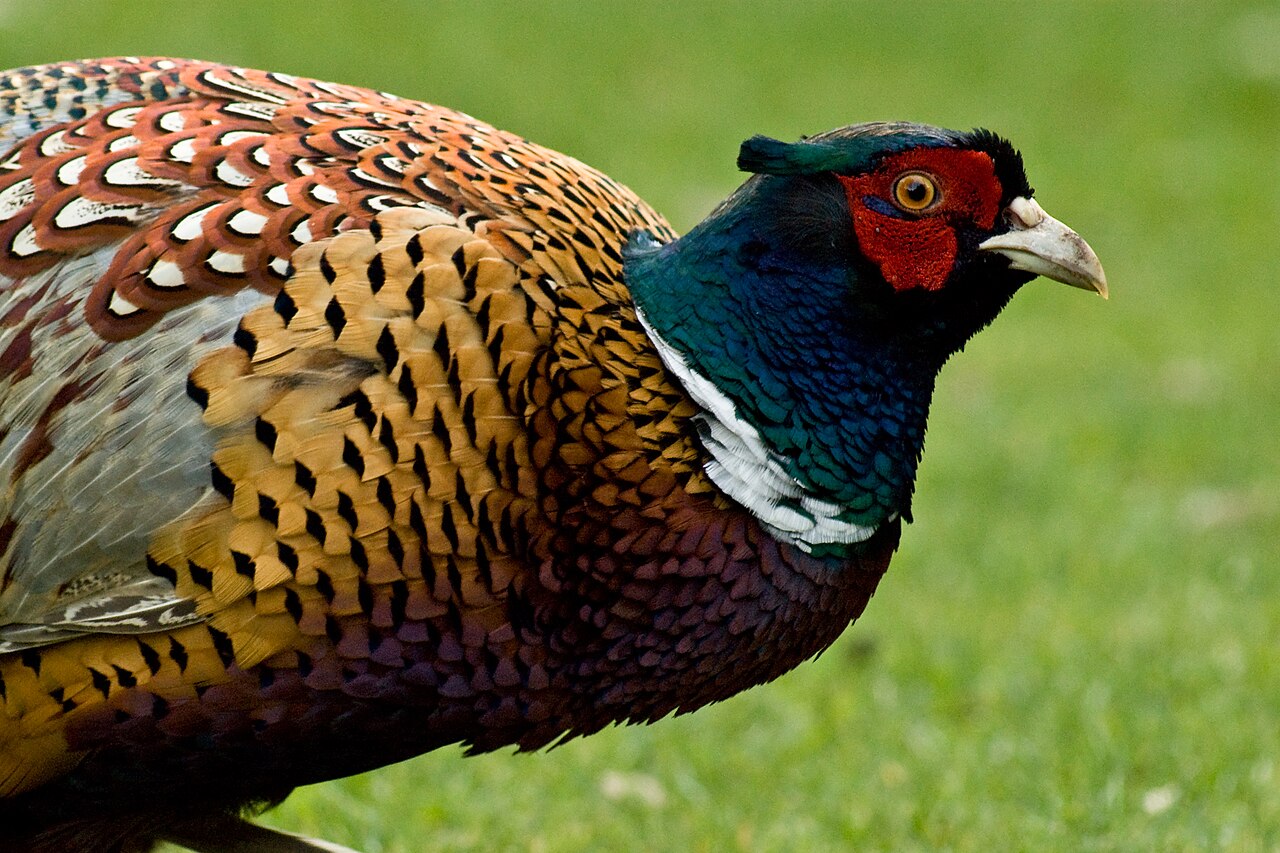
An accidental masterpiece
The common pheasant, Phasianus colchicus, is not from here. It belongs to a band of country running from the Caucasus and the Caspian east through Central Asia to China, Korea and Japan. Its scientific name is a piece of ancient geography: the Greeks knew it from the river Phasis in Colchis, in what is now Georgia. Romans carried it west, and by the medieval period it was established in Britain.
What arrived was a bird built by a completely different landscape and dropped into ours, where it looks frankly implausible. Nothing native to a Northamptonshire hedge has any business being that colour.
- ~30recognised subspecies
- 60 mphburst flight speed
- Hoursbefore chicks leave the nest
- 2,000 yrsroughly, in Europe
Why they are extraordinary
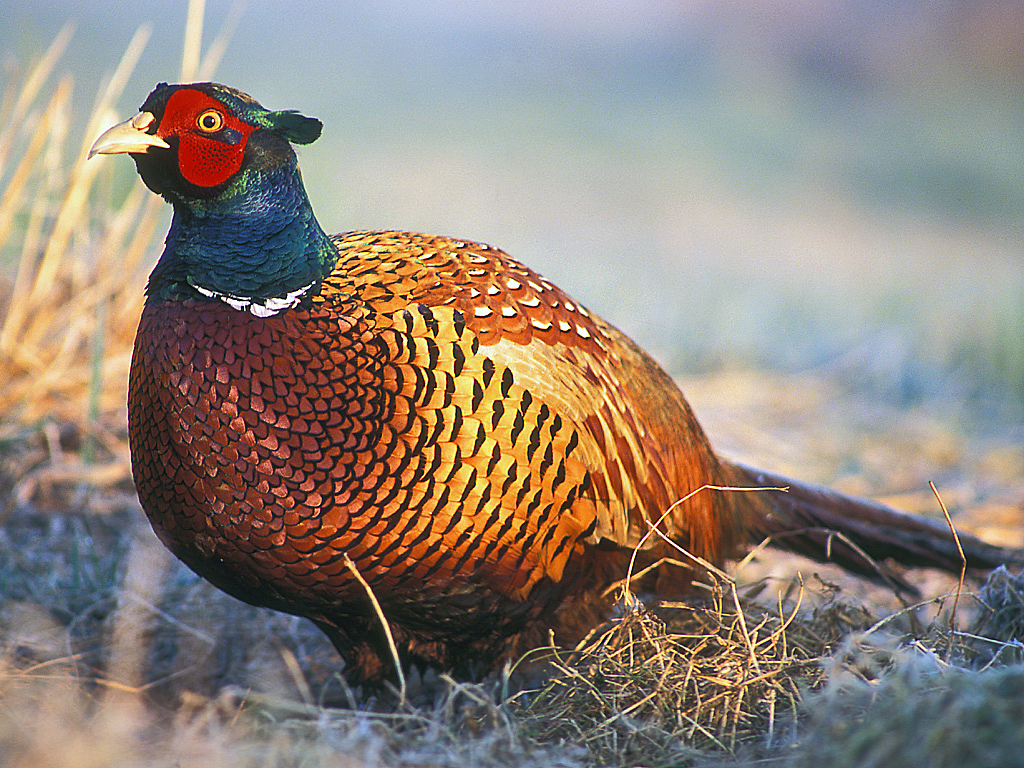
- The colour is a trick of physics. That green-purple sheen on the head is not pigment. It is structural colour — microscopic layers in the feather scattering light — which is why a cock pheasant changes from black to emerald to bronze as he turns. In flat cloud he is a brown bird. In low sun he is a stained-glass window.
- The red face is a live billboard. Those scarlet wattles swell and brighten with hormone levels in spring. Hens read them, and researchers have shown that the size of a male's wattles and ear-tufts predicts his success. Nothing about the display is idle decoration.
- The take-off is one of the most explosive in the bird world. Pheasants are near-flightless most of the time, then convert to a vertical rocket in under a second. The breast muscle is almost pure white fibre — enormous anaerobic power, no endurance. It is the same trade-off a sprinter makes, taken to an extreme.
- The chicks are competent almost immediately. They hatch covered in down with their eyes open, leave the nest within hours, and can flutter up into cover at less than two weeks old. Compare that with a blue tit, naked and blind for a fortnight.
- They are alert to things we cannot detect. Pheasants are famous in Japan for calling before earthquakes; the plausible explanation is sensitivity to low-frequency ground vibration well below our hearing.
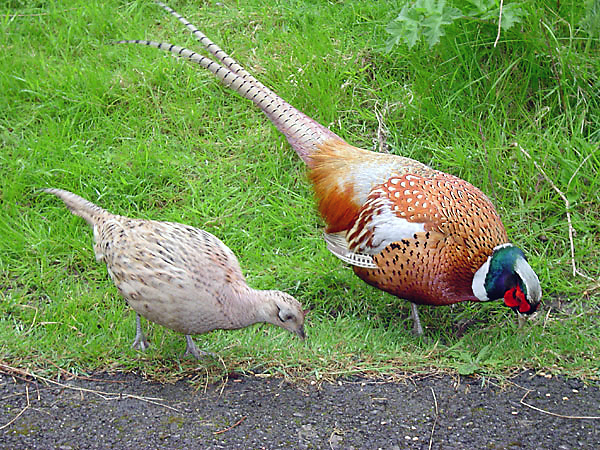
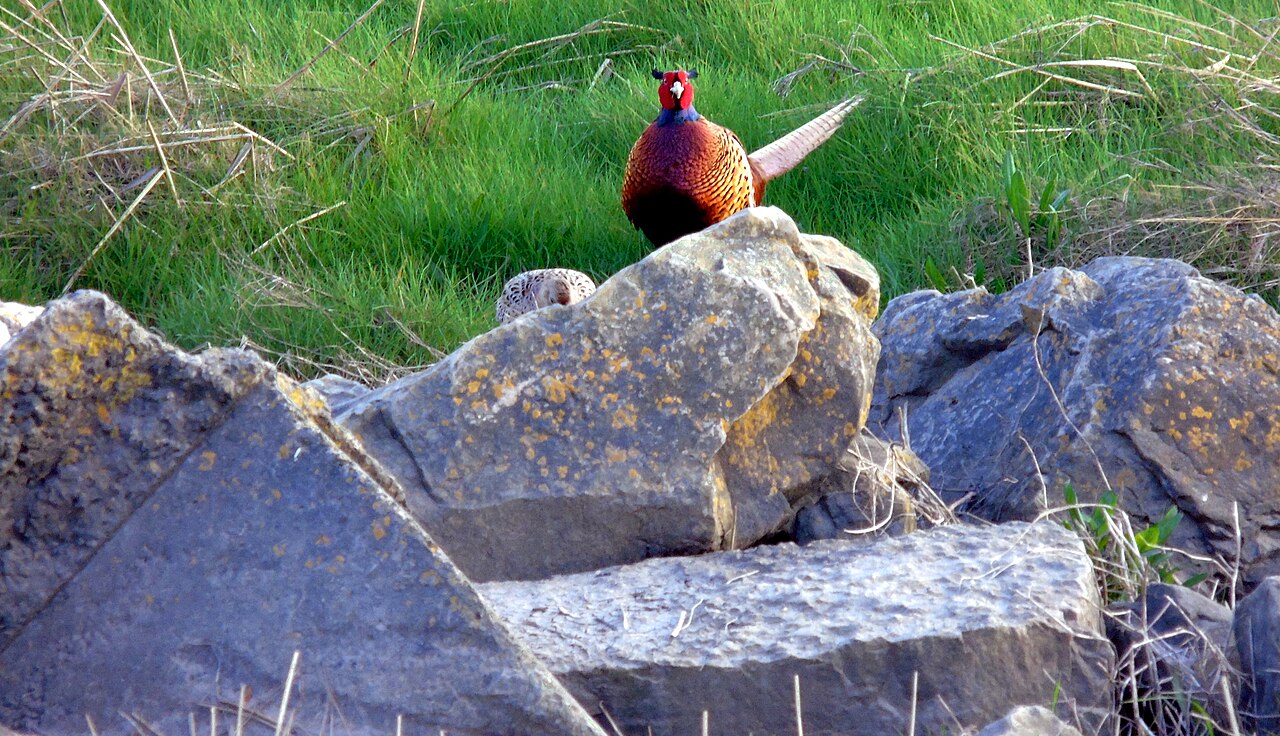
- They have social lives. Cocks hold territories and gather harems. Hens choose. Birds recognise individuals, keep grudges, and squabble over rank in ways that anyone who has watched a group in a stubble field will recognise instantly.
A cock pheasant in October sunlight is the most spectacular bird you can see from a British footpath. We have simply decided not to look at him properly.
Pictures
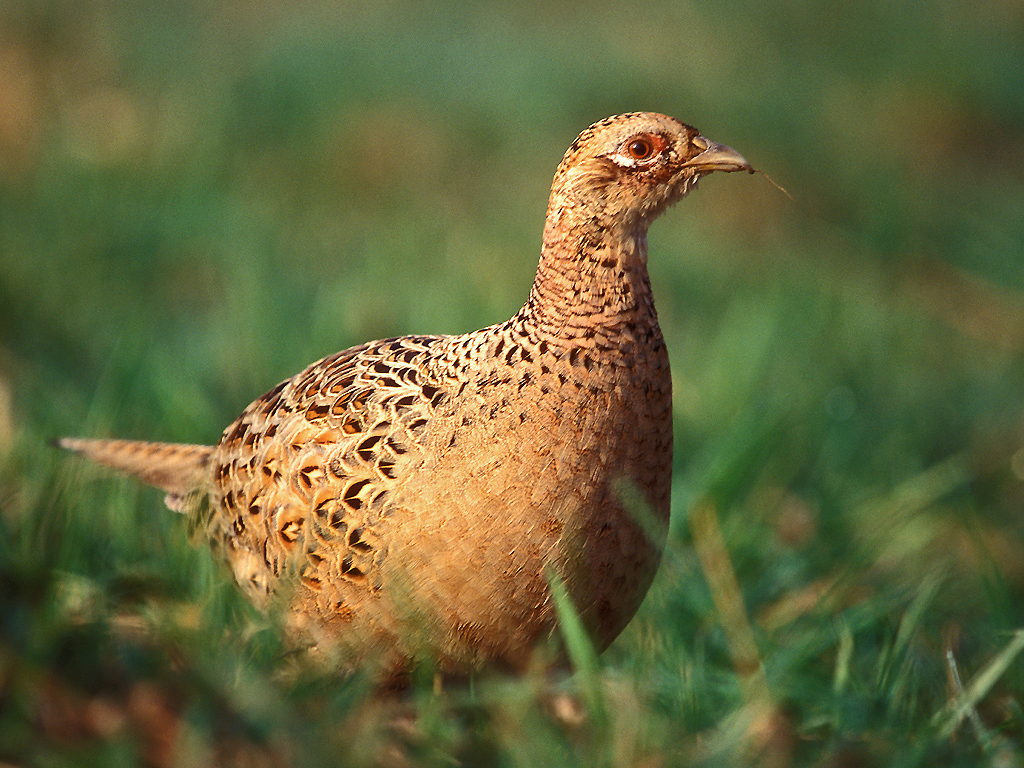
Photographs from Wikimedia Commons — click a caption for the original and its licence.
Why we shouldn't kill them
Around 40–50 million pheasants are reared and released into the British countryside every year, almost entirely so that they can be shot. Here is the case for stopping.
-
They are not really wild
The overwhelming majority are hatched in incubators, raised in pens, and released weeks before the season starts. A bird that has been hand-fed its whole life and has no fear of people is not a wild quarry. Calling it sport flatters the arrangement.
-
Most of the releasing is waste
Only a fraction of released birds are ever shot. Large numbers die on roads, of exposure, or of disease. And because supply massively exceeds appetite — few people now cook pheasant — shot birds have repeatedly been reported buried or dumped rather than eaten. Killing on that scale for food nobody wants is hard to defend on any grounds.
-
Lead shot poisons everything downstream
Birds shot with lead leave fragments in the carcass and in the field. That lead is eaten by scavengers — buzzards, red kites, corvids — and by people. There is no safe blood-lead level in humans, and lead is a well-documented cause of poisoning in wild birds. A voluntary move to steel has been slow and patchy.
-
The sheer biomass distorts the countryside
Released gamebirds now make up an extraordinary share of the total weight of birds in Britain in late summer. That volume of grain-fed birds inflates predator numbers, strips invertebrates and reptiles from release areas, and changes woodland ground flora through trampling and nutrient loading. The problem is not the pheasant. It is the industrial scale at which we manufacture them.
-
Welfare before the gun
Breeding stock has been kept in small raised cages, and birds have been fitted with bits and masks to stop stress-induced pecking in crowded pens. Whatever you think of shooting itself, the months that precede it are the part nobody photographs.
-
The simplest reason
A pheasant is a curious, alert, social animal with a life it is plainly interested in keeping. Wanting to look at one is a better reason to have it in the field than wanting to shoot it, and it lasts considerably longer.
What to do instead
Walk a field edge at dusk in late October and watch a cock pheasant come out to feed. Learn the alarm — that clattering kok-kok followed by a whirr of wings. Notice how the colour changes as he turns. Drive a bit slower down lanes in autumn, when young birds sit in the road. Buy from farms that do not release, and if you eat game, ask what it was shot with.
Then go back to the bird guide and see how many of the others you can put a name to.
Figures for annual releases are estimates and vary between sources; they are widely reported in the range of 35–57 million birds. Photographs are used under their Wikimedia Commons licences — follow the source links for author and licence details. The photograph at the top of this page is Common Pheasant Phasianus Colchicus.