Face it north to east
Anywhere between north and east. It keeps the hole out of the hot midday sun and away from the wet south-westerlies. A box facing south-west can cook a brood.
One plank, one afternoon
A standard small-hole box takes a single 1.5 metre plank, six cuts and about two hours. Get the hole size and the siting right and there is a genuine chance of blue tits in it by April.
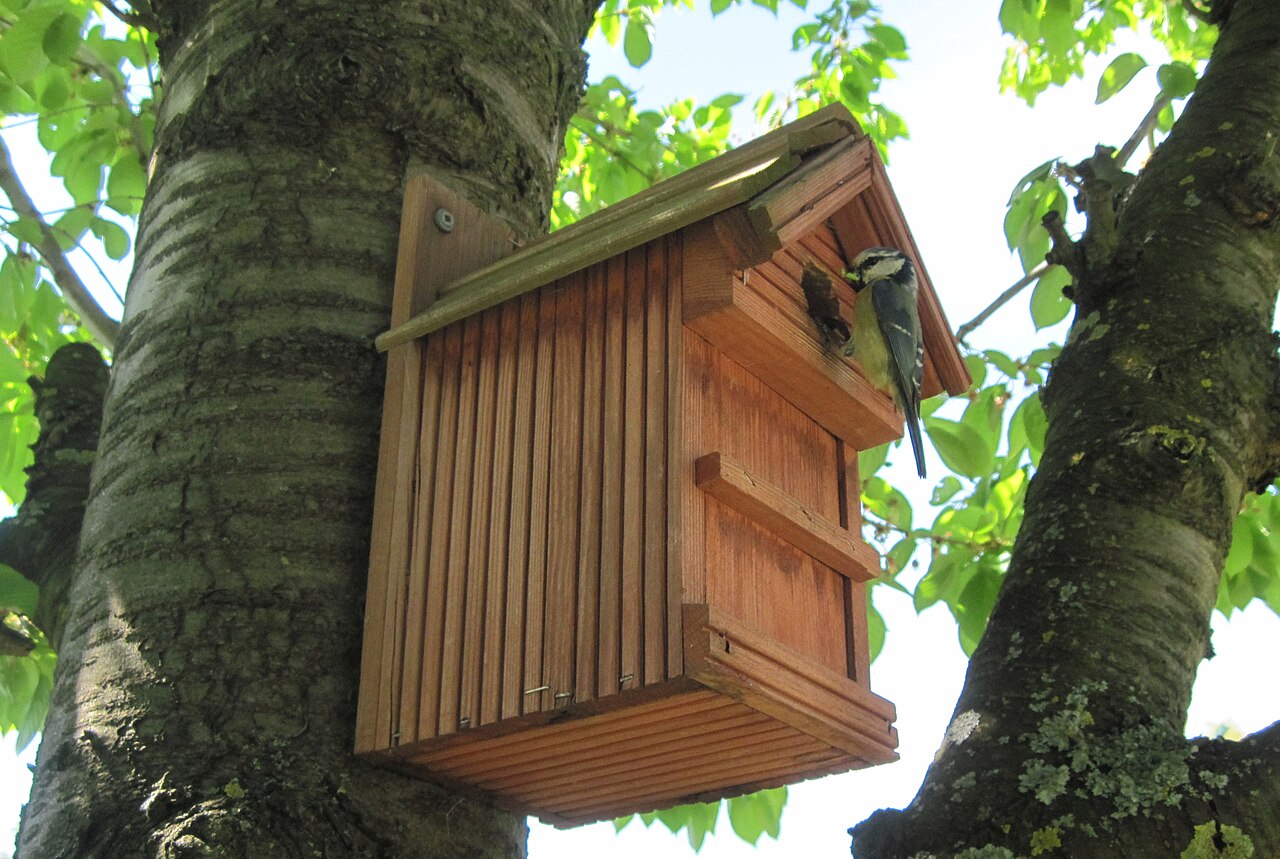
The whole box comes out of one piece of timber. Rough-sawn is better than planed — the chicks need something to grip when they climb to the hole.
Not plywood, MDF, or anything pressure-treated or painted on the inside. Plywood delaminates within a season or two outdoors, and treatment chemicals sit in a small sealed box with baby birds in it.
Six pieces, cut in order along the plank. Everything is the full 150 mm board width except the base.
Cut both side pieces on a slope, from 250 mm at the back edge down to 200 mm at the front. That slope is what tilts the roof so rain runs off. Everything else is a square cut.
The base sits between the two side panels rather than under them, so the end grain is not exposed to rain. Drill four drainage holes through it before you fix anything — a wet box is a dead brood.
Screw the front and back panels onto the front and back edges of the sides. The back is deliberately long: the extra 100 mm top and bottom is where you fix the box to the tree, so the box itself stands clear of the trunk.
Centre it about 50 mm below the top edge of the front panel. That puts it around 135 mm above the floor, which is deep enough that a cat or a magpie cannot reach the chicks and the chicks cannot fall out.
Every shop-bought box seems to have one and it does nothing for the birds — they can cling to the wood perfectly well. All it adds is a convenient foothold for predators.
Fix the rubber strip across the joint between the back and the roof, and add a hook and eye at the front. You need to get in once a year, and a screwed-down roof means you will not bother.
If you treat it at all, use a water-based preservative on the outside faces and let it air for a fortnight before it goes up. The inside stays bare wood.
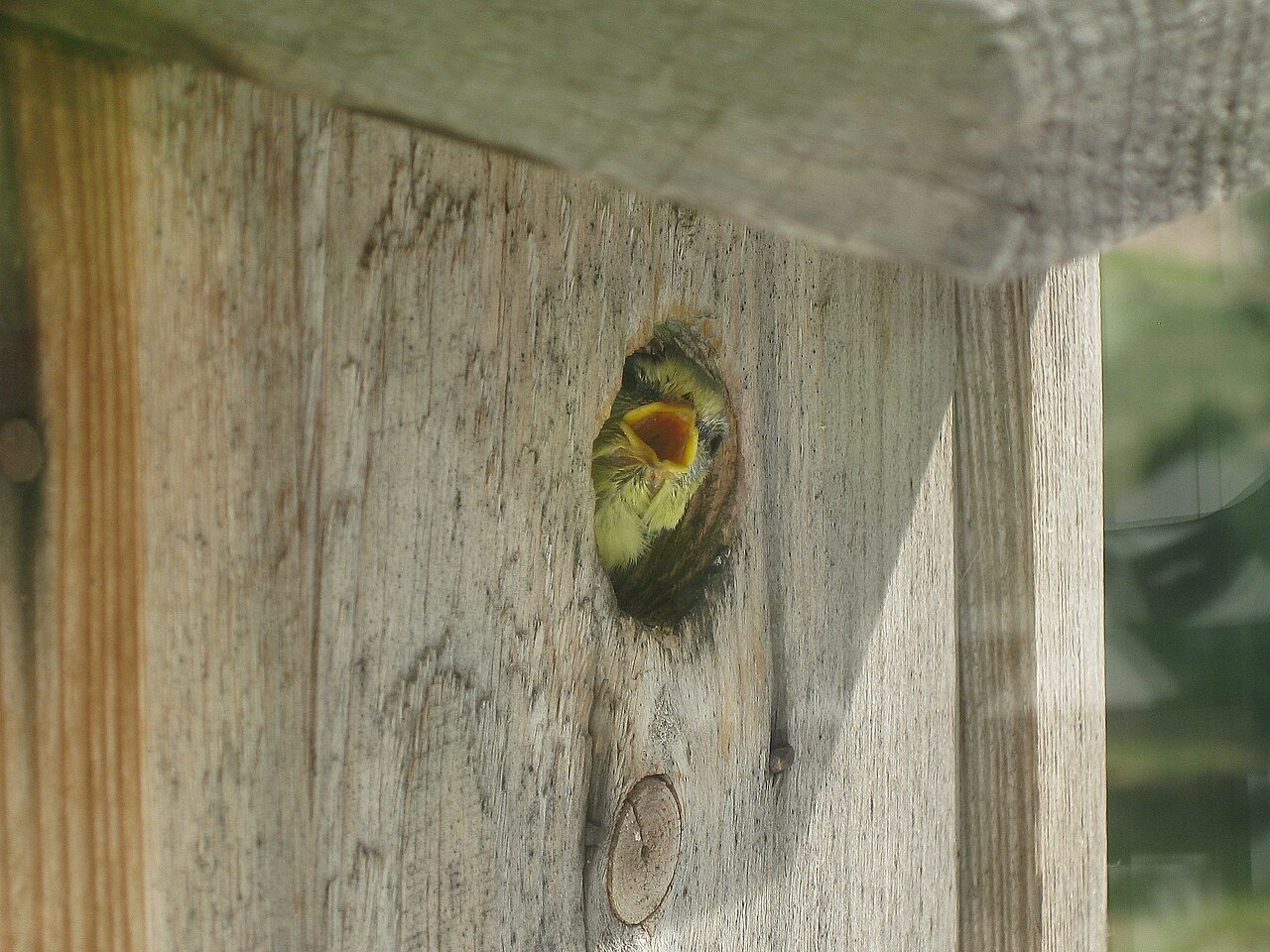
This one number does more than anything else to determine what moves in. A few millimetres is the difference between blue tits and house sparrows.
| Hole | Suits | Notes |
|---|---|---|
| 25 mm | Blue tit, coal tit, marsh tit | The safest default. Keeps larger, pushier birds out. |
| 28 mm | Great tit, tree sparrow, pied flycatcher | Blue tits will still use it, but so will their competition. |
| 32 mm | House sparrow, nuthatch | Nuthatches will plaster the hole down to their own preferred size with mud. |
| 45 mm | Starling | Needs a deeper box — allow at least 200 mm from hole to floor. |
| Open front | Robin, wren, spotted flycatcher, pied wagtail | Cut the front panel down to about 100 mm tall, leaving the top open. |
A well-built box in the wrong place stays empty. This is the part people get wrong.
Anywhere between north and east. It keeps the hole out of the hot midday sun and away from the wet south-westerlies. A box facing south-west can cook a brood.
High enough to be out of reach of cats. Open-fronted boxes are the exception — put those low, under two metres, and buried in a hedge or climber.
A slight forward lean sheds rain off the front rather than letting it run in through the hole. Never tilt it back.
Leave an unobstructed flight path to the hole. Keep it away from feeders too — the constant traffic of other birds puts nesting pairs off.
Most small birds are territorial in the breeding season, so one box per garden of small hole size is usually the realistic limit. Sparrows are the exception and will happily nest in a terrace.
Autumn is better still. Birds roost in boxes through the winter, and a box they already know is one they are far more likely to nest in come spring.
In the UK it is an offence under the Wildlife and Countryside Act 1981 to intentionally disturb a nesting bird, damage or destroy an active nest, or handle the eggs. That includes lifting the lid for a look. However tempting it is, do not.
Clean it out once a year, between 1 August and 31 January. That is the only window when the box is legally certain to be empty. Lift out the old nest, pour boiling water through to kill parasites, and let it dry completely. No insecticides, no flea powders, and do not add your own nesting material — the birds bring their own and will reject yours.
If you find unhatched eggs during that window you may remove them, but only then, and they must be destroyed rather than kept.
Dimensions here are a working guide rather than the only correct answer — nest boxes are forgiving, and the numbers that really matter are the hole diameter, the depth below it, and which way it faces. The RSPB and the BTO both publish free plans worth comparing against. Photographs from Wikimedia Commons: box with blue tit.